
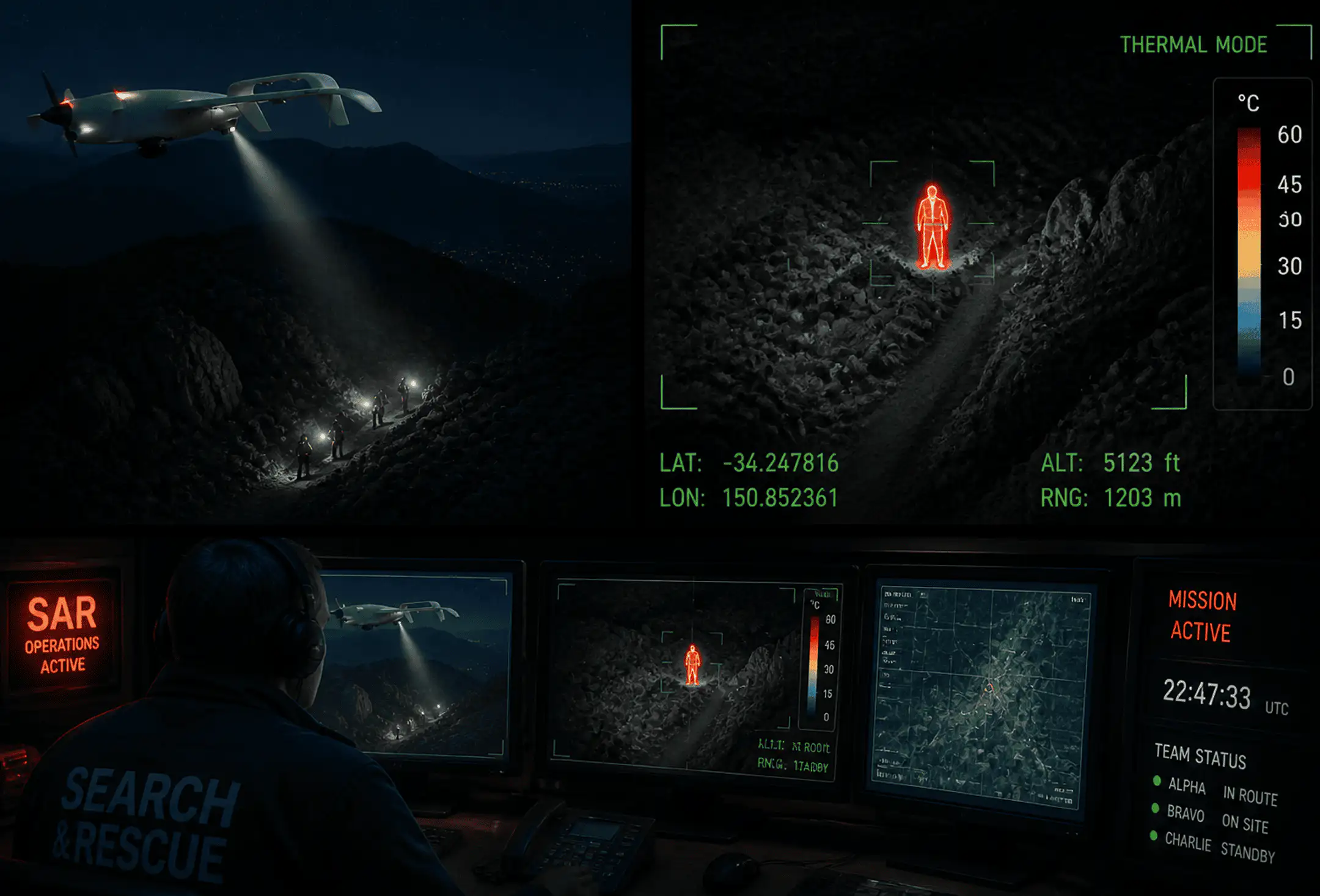
Every minute matters in search and rescue operations. When missing persons disappear into remote mountains, dense forests, or coastal wilderness, traditional ground-based search methods face critical limitations: restricted visibility, difficult terrain, and the sheer time required to cover large search areas. Thermal imaging from long-endurance UAVs introduces a game-changing capability that significantly improves rescue success rates.
The Search & Rescue Challenge
Search and rescue teams face a fundamental problem: finding a single human in vast wilderness before conditions deteriorate. Traditional approaches include:
- Ground teams: Limited to accessible terrain, slow coverage speed
- Helicopter searches: Expensive, weather-dependent, limited flight time
- Canine units: Effective but slow, require direct terrain access
- Communication-based: Assumes missing person can signal or respond
In rugged terrain—mountain canyons, dense forest, or disaster zones—these methods become increasingly inefficient. A missing hiker in mountainous terrain, a person lost at sea, or a civilian in a conflict zone requires rapid, wide-area visibility that ground teams cannot provide.
How Thermal Imaging Changes the Equation
Raybird’s integrated EO/IR thermal imaging payload detects human heat signatures from altitude, fundamentally accelerating the search process. Here’s how:
Human Heat Signature Detection
The human body maintains a temperature of approximately 98.6°F (37°C), which creates a distinct thermal signature against cooler environmental backgrounds. Raybird’s thermal imaging sensor identifies these signatures from operational altitudes up to 5,500 meters, scanning terrain from a wide vantage point impossible for ground teams to achieve.
Wide-Area Coverage in Minimal Time
With 28+ hours of endurance, Raybird can cover search zones that would require ground teams days to traverse. A single sortie can systematically scan hundreds of square kilometers of wilderness, with continuous telemetry transmission allowing operators to monitor the search in real time from a command center. This wide-area capability is especially critical in the initial hours when missing persons are most likely to be found alive.
Day and Night Operation
Unlike visual search methods that degrade at dusk, thermal imaging maintains detection capability 24/7. Missing persons are often found during darkness or low-visibility conditions—precisely when thermal imaging provides the greatest advantage. Raybird can conduct continuous overnight searches, maintaining search momentum without weather-related delays.
Rapid Coordinate Transmission
Once a heat signature is confirmed as human (distinguishing from wildlife or thermal anomalies), exact GPS coordinates are transmitted immediately to ground rescue teams via Raybird’s 220km telemetry link. This precision targeting allows rescue personnel to navigate directly to the subject rather than conducting grid searches, dramatically reducing on-ground search time.
Operational Process in Practice
A typical search & rescue deployment follows this sequence:
- Rapid Deployment: Raybird launches within 25 minutes of mission assignment
- Search Grid Setup: Autonomous route programmed to systematically cover defined search area
- Continuous Thermal Scan: EO/IR payload monitors terrain throughout flight
- Real-Time Analysis: Operators identify potential human signatures and verify targets
- Coordinate Transfer: GPS data of confirmed targets sent to ground rescue teams
- Extended Coverage: 28-hour endurance allows search continuation without crew rotation
Real-World Application
Consider a realistic scenario: a hiker becomes lost in mountain terrain during late afternoon. By the time search is officially declared, darkness is approaching. Ground teams face dangerous night navigation and limited visibility. Raybird can launch within minutes, scan the expected search area throughout the night using thermal imaging, and provide rescue teams with exact coordinates of the missing person before dawn. This advantage—finding subjects during darkness when they’re most vulnerable—directly improves rescue outcomes.
Technical Specifications That Matter
Raybird’s specifications support effective search & rescue:
TECHNICAL SPECIFICATIONS
Flight Endurance
28+ hours
Wingspan
Wingspan
Max Take-Off Weight
23 kg
Max Mission Range
2,500 km
Operational Ceiling
5500 m
Telemetry Link Range
up to 220 km
Payload Capacity
5–10 kg
Cruise Speed
80 / 110 / 140 km/h
Engine Type
EFI four-stroke engine
Fuel Type
Gasoline AI-95
Deployment Time
up to 25 min
Operating Temperature
-35°C to +55°C
Beyond Basic Detection
Modern thermal imaging systems integrated with UAV platforms offer additional advantages: target movement tracking, heat pattern analysis for distinguishing humans from wildlife, and integration with rescue command centers for real-time situational awareness.
Search and rescue organizations from mountain regions to coastal zones are increasingly integrating long-endurance thermal UAVs into standard response protocols. The capability has proven itself across hundreds of successful rescue operations, reducing search duration and improving survival rates.