
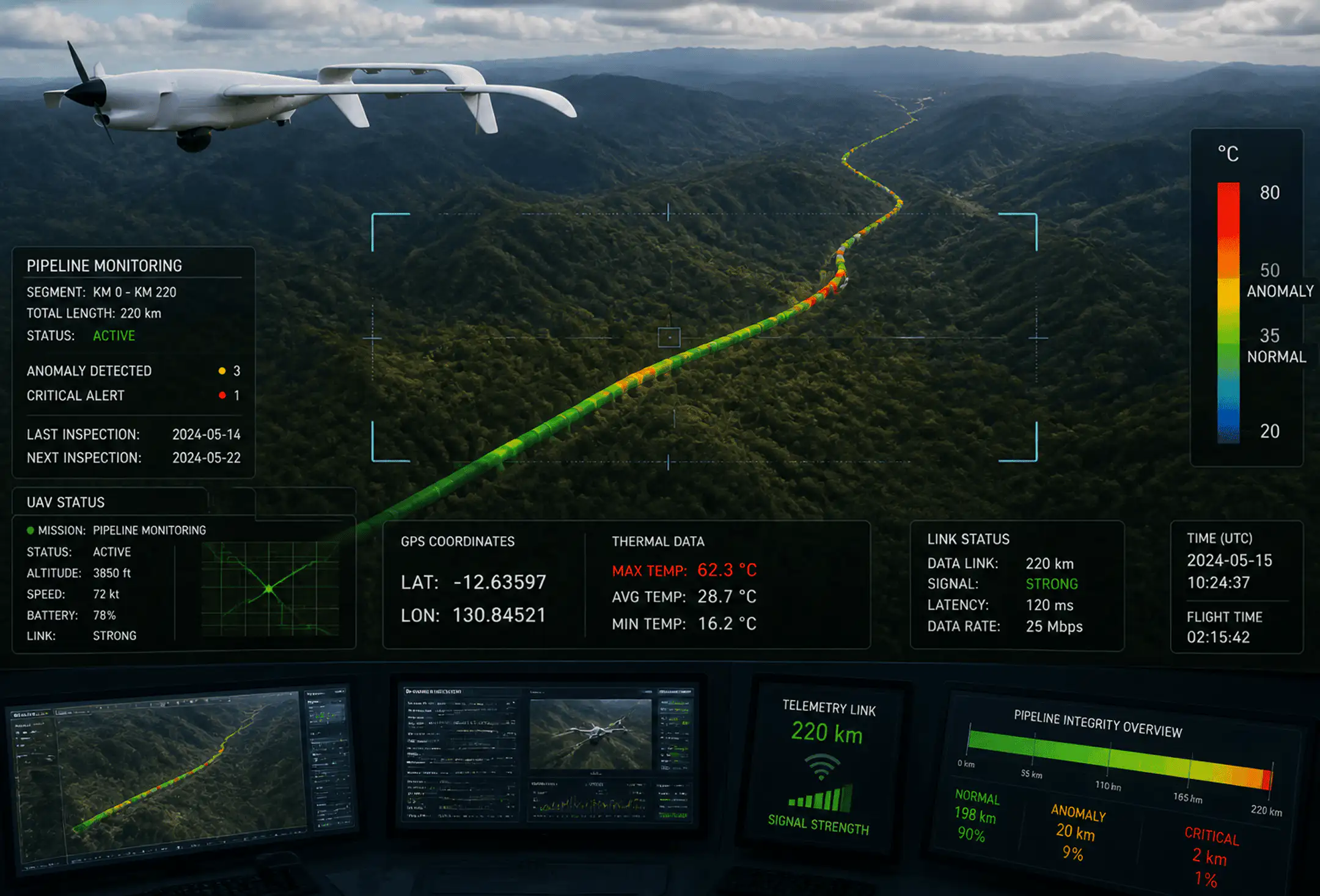
Critical infrastructure—pipelines, power transmission lines, and industrial facilities—often extends across remote, difficult terrain. Traditional inspection methods require personnel to physically access these locations, creating safety risks and consuming substantial time and resources. Long-distance telemetry-enabled UAV monitoring transforms infrastructure inspection into a safer, faster, and more cost-effective operation.
The Infrastructure Inspection Dilemma
Power companies, pipeline operators, and industrial facilities face persistent inspection challenges:
- Access difficulty: Transmission lines cross mountains, forests, and water bodies
- Personnel safety: Ground and rope-access inspections expose workers to hazards
- Time consumption: Manual inspections of 100+ kilometer routes require days of field work
- Detection delays: Problems may escalate between periodic inspection cycles
- Weather dependency: Ground-based inspections halt during adverse conditions
A 200-kilometer pipeline corridor might require weeks of ground-based inspection to identify corrosion, leaks, or structural issues. During that time, undetected problems can escalate into costly failures or environmental incidents.
How Long-Distance Telemetry Changes Infrastructure Monitoring
Raybird’s 220-kilometer telemetry range enables operators to conduct aerial inspections from a remote command center, eliminating personnel exposure to hazardous locations while maintaining continuous real-time data feedback.
Extended Range Telemetry Architecture
Unlike short-range UAV systems requiring constant line-of-sight, Raybird’s telemetry system maintains encrypted data links across 220km of distance. This exceptional range means operators can monitor infrastructure corridors from safe ground locations, receiving continuous video, thermal imaging, and sensor data without requiring the UAV to remain directly overhead.
Thermal Anomaly Detection for Infrastructure Problems
Raybird’s EO/IR thermal imaging identifies heat signatures indicating potential problems:
- Pipeline leaks: Temperature differentials around corrosion or rupture points
- Power line faults: Thermal hotspots indicating electrical stress or overload
- Equipment degradation: Temperature anomalies in transformers, switchgear, or junction points
These thermal signatures often appear before visual damage becomes apparent, enabling preventive maintenance rather than reactive emergency repair.
Uninterrupted Inspection Coverage
With 28+ hours of endurance, a single Raybird sortie can inspect 100+ kilometers of infrastructure in one continuous flight. Pre-programmed autonomous routes follow pipeline or transmission line corridors, with optical and thermal imaging continuously recording corridor conditions. This continuous coverage prevents inspection gaps that might miss early-stage problems.
Real-Time Data Transmission
Critical findings are transmitted immediately to operations teams. A thermal anomaly indicating potential pipeline corrosion triggers instant alerts, enabling teams to stage maintenance crews or schedule closer inspection before deterioration advances. This real-time capability compresses inspection cycles from weeks to days.
Practical Application: Pipeline Corridor Inspection
Consider a 150-kilometer pipeline crossing mountainous terrain. Traditional inspection requires:
- Ground crews accessing terrain (days to weeks)
- Rope access specialists for difficult sections (high risk, high cost)
- Weather delays during rain or snow
- Multiple site visits to address findings
Raybird enables alternative approach:
- 24-hour autonomous patrol of entire corridor via pre-programmed route
- Thermal and optical imaging simultaneously capturing pipeline and surrounding terrain
- Real-time hotspot detection identifying potential problem areas
- Immediate coordinate transmission allowing maintenance teams to precisely target inspection areas
- Complete coverage documentation creating baseline for future comparison
Total inspection time: 24-36 hours versus weeks. Personnel exposure: minimal versus extended. Cost: fraction of traditional ground inspection.
Technical Specifications Supporting Long-Distance Inspection
Raybird’s design specifically supports infrastructure monitoring:

300k+
Mission Hours

1000+
UAV Systems Delivered

28h+
Maximum Endurance

80%
In-House Components
Safety and Environmental Considerations
UAV-based inspection eliminates personnel from hazardous environments:
- No rope-access risk on transmission towers
- No ground-level exposure to pipeline rupture hazards
- No traffic exposure for roadside infrastructure work
- Reduced environmental disturbance (no ground vehicle access to remote locations)
Operational Reliability at Scale
Skyeton reports 300,000+ mission hours supporting infrastructure operators globally. This operational history demonstrates Raybird’s reliability in demanding conditions: maintaining thermal imaging integrity, sustaining 220km telemetry links across varied terrain, and delivering consistent data quality across complete inspection routes.
Regulatory and Compliance Advantages
Infrastructure operators face increasing regulatory requirements for inspection frequency and documentation. UAV-based inspection provides:
- Complete visual documentation of every kilometer monitored
- Thermal baseline data for trending analysis
- Precise GPS-tagged findings for regulatory reporting
- Repeatable inspection protocols enabling consistent compliance
Ready to modernize your infrastructure inspection capability? Contact Skyeton to discuss long-distance monitoring solutions for your critical assets.